What Healthy Gums Look Like, and Signs to Watch
We may earn a commission when you buy through links on this page, at no extra cost to you. Learn more
Healthy gums are usually pale to coral pink, or naturally darker where pigmentation is normal. They feel firm, fit snugly around each tooth, often look slightly dotted like orange peel, and don't bleed with gentle brushing. Your own usual look matters most. Lasting redness, swelling, bleeding or receding gums are worth a dental check.
Alongside brushing, flossing and regular dental visits, many readers add a daily oral probiotic to their routine.
Visit the official ProDentim site60-day money-back guarantee

On this page
- What do healthy gums look like?
- What colour should gums be, and what counts as normal variation?
- Healthy gums vs unhealthy gums: what is the difference?
- A 2-minute gum self-check you can do at home
- When should I book a dental check?
- What can help keep gums looking healthy?
- Where does this fit with gum health and probiotics?
What do healthy gums look like?
Healthy gums are usually pale to coral pink, firm, snug around each tooth, and they don’t bleed with gentle brushing. If yours look a little different, don’t panic. Mouths vary a lot.
Colour
Healthy gum colour is typically pale pink to coral pink, and it should look fairly even. Pale pink is normal for many people. You don’t need to match a paint chart.
Texture and shape
Healthy gum tissue (the gingiva) often has fine dimples called stippling, a bit like orange peel. Some people have smoother gums and are still healthy. The gum edge should look thin and scalloped, with a small pointed triangle of gum filling each gap between teeth.
Firmness and fit around the teeth
Healthy gums feel firm, not puffy, and hug each tooth neatly. They shouldn’t bleed during normal brushing and flossing. Think of a snug sock rather than a loose, bunched one.
What colour should gums be, and what counts as normal variation?
Gum colour ranges from pale pink to coral pink to brown, and what matters most is whether yours has changed from your own normal. Variation is common and rarely alarming by itself.
Pale pink and coral pink gums
Pale pink and coral pink are the two textbook shades. Both can be healthy. Lighter skin often goes with lighter gums, but it’s not a rule.
Darker or patchy gums that are natural
Natural pigment, called melanin, can make gums brown or give them darker patches. If the colour has always been there, it’s usually just how your mouth is made. A new dark spot, or one that changes or grows, is worth showing a dentist.
Lower gums versus upper gums
Lower front gums are often thinner, so they can look slightly different from the upper ones. That alone is rarely a worry. Compare the same area over time instead.
Quick tip: Your own baseline beats any chart. Learn what your gums look like on a good day.
Healthy gums vs unhealthy gums: what is the difference?
Healthy gums are pink, firm and snug, while unhealthy gums often look red, puffy, shiny or tender and may bleed. Early gum irritation is common and often manageable with a dentist’s guidance.
Side-by-side comparison
| Feature | Typically healthy | Worth a dental check |
|---|---|---|
| Colour | Pale to coral pink, or naturally darker | Bright red, dark red or a new colour change |
| Swelling | None; gums look slim | Puffy, swollen or shiny |
| Texture | Fine stippling or smooth, firm | Smooth, glossy and soft |
| Edge shape | Thin, scalloped, pointed between teeth | Rounded or rolled edges |
| Bleeding | None with gentle brushing | Bleeds when brushing or flossing |
| Gum line | Covers the tooth neck evenly | Teeth look longer, gums pulling back |
| Feel and smell | Comfortable, fresh | Tender, bad taste or breath |
What unhealthy or bad gums can look like
Unhealthy gums can look red, puffy and shiny, with rounded edges. The usual early form is gingivitis, which means gum inflammation. It’s often linked to plaque, the sticky film of bacteria on teeth. For more on this stage, see our guide to gum inflammation.
Bleeding can show up before redness or swelling does. A classic review found that bleeding is an earlier sign of gingivitis than visible redness and swelling. If you wonder why it happens, read why gums bleed.
Periodontitis is a more advanced gum disease. A review notes it is usually painless, with bleeding, redness, swelling, pus and shifting teeth as symptoms. That’s why checking by eye matters.
A 2-minute gum self-check you can do at home
A gum self-check takes about two minutes with a mirror and good light. Go slowly and look at every area.
What you need
- A bright light or your phone torch
- A mirror
- Clean hands
- Your phone for photos
Step-by-step checklist
Check upper and lower gums, front and back, cheek side and tongue side. Gently pull your lip out to see the outer gum.
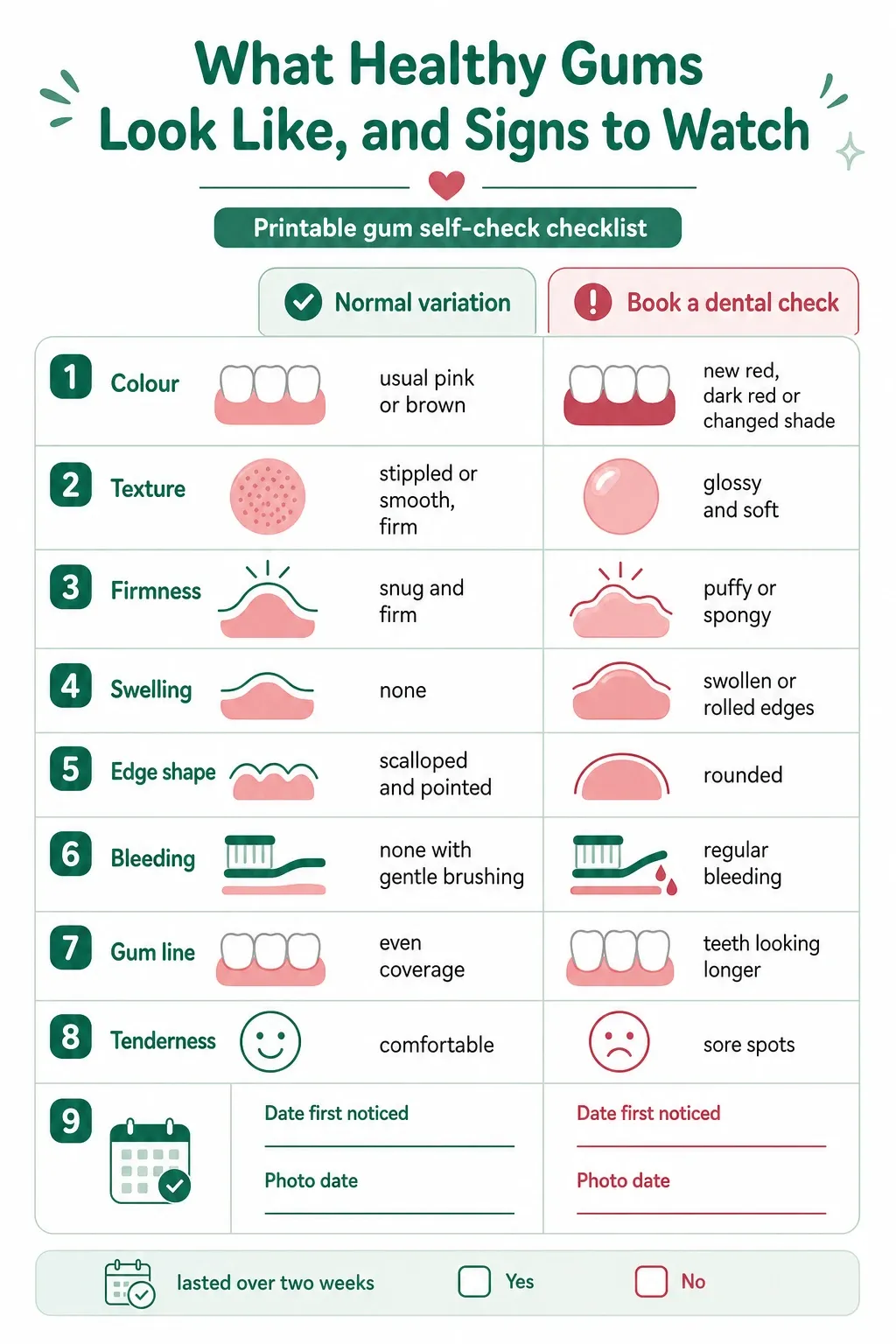
- Colour: Is it your usual pink or brown, or is there new redness?
- Texture: Is it stippled or smooth, and has that changed?
- Firmness: Does it feel firm, or soft and puffy?
- Swelling: Any lumps or shiny, rounded areas?
- Edge shape: Are the points between teeth still sharp?
- Bleeding: Does anything bleed when you brush or floss?
- Gum line: Do any teeth look longer than before?
- Tenderness: Is any spot sore to touch?
What to note down
Write the date you first noticed anything odd. Note anything lasting more than two weeks. Take a phone photo in the same light each time so you can compare.
When should I book a dental check?
Book a dental check if your gums bleed regularly, look red or swollen for a while, or are pulling back. A dentist or hygienist can find the cause. This page can’t diagnose anything.
Signs worth a dentist visit
- Gums that bleed regularly
- Redness or swelling that doesn’t settle
- Sore or tender gums
- Gums pulling back, which you can read about in our receding gums guide
- Loose teeth or teeth that seem to shift
- A lasting bad taste or breath
A dental hygienist is a trained professional who cleans teeth and gums and teaches home care. A dental check-up is also a good time to ask about any changes.
Signs that need prompt attention
See a dentist or doctor quickly for facial swelling, severe pain, fever, or pus. Do the same for a white or red patch that is still there after about two weeks. Don’t wait for the next routine visit.
What can help keep gums looking healthy?
Gentle daily cleaning and regular dental visits are what help most. Gum changes are rarely anyone’s fault.

Hormones, some medicines and genes all play a part. A review lists plaque, smoking, diabetes, stress and genetic traits as risk factors for periodontitis.
- Brush twice a day along the gum line with a soft-bristled toothbrush and fluoride toothpaste.
- Clean between teeth daily. Flossing or small interdental brushes both count.
- Keep up regular check-ups and cleans.
- Tell your dentist if you smoke or have a health condition. A review describes how gum disease and diabetes or heart disease are linked.
Press lightly. Hard scrubbing can irritate gums rather than help them.
Where does this fit with gum health and probiotics?
Knowing what healthy gums look like gives you a baseline before you try anything new. Our guide to probiotics for gum health covers what research says about friendly mouth bacteria. For a wider view, see our overview of oral probiotics.
Probiotics don’t replace brushing, cleaning between teeth or dental care. If your self-check turns up something that worries you, start with a dentist.
Frequently asked questions
Are pale pink gums normal?
Yes, pale pink gums are normal for many people. Healthy gums range from pale pink to coral pink, and some people have naturally darker gums. What matters is that yours look firm and even, don’t bleed with gentle brushing, and haven’t changed lately.
Can healthy gums bleed a little?
Healthy gums shouldn’t bleed with gentle brushing and cleaning. Occasional bleeding after a new routine or harder scrubbing can happen. If bleeding keeps happening for more than about two weeks, it’s worth having a dentist or hygienist look at it.
How long should I wait before seeing a dentist about red gums?
If red gums haven’t improved after about two weeks of gentle, careful cleaning, book a dental check. Go sooner if you have swelling, pus, a loose tooth, fever or severe pain. A dentist can find the cause and advise you.