Best Probiotic Mouthwash: Does It Make Sense and What to Check
We may earn a commission when you buy through links on this page, at no extra cost to you. Learn more
Probiotic mouthwash exists, and small trials report gains for plaque and gum bleeding. Live bacteria are hard to keep alive in a liquid, though, so check for named strains, a live-culture count and no alcohol. If you want a steady daily dose, a chewable or lozenge is the easier form. Our top all-round pick is ProDentim, a daily chew. Keep brushing and flossing either way.

On this page
- Quick verdict
- Does probiotic mouthwash actually work?
- How we judge a probiotic mouthwash: the buying criteria
- Probiotic mouthwash compared: rinses versus chewables and lozenges
- Which is better for bad breath: probiotic or antibacterial mouthwash?
- Does it help gums, plaque and tonsil stones?
- Is probiotic mouthwash good for gut health or when taking antibiotics?
- Where this fits in oral probiotics
- Our pick: when a chewable oral probiotic makes more sense
Quick verdict
Probiotic rinses can fit your routine, but a chewable or lozenge gives you the most dependable daily dose.
- Want the easiest all-round option? ProDentim is a daily chew, not a rinse. It lists three named strains, and the maker says each chew carries 3.5 billion good bacteria. It comes with a 60-day refund window.
- Want two well-known breath strains? Burst Oral Health Probiotics names BLIS K12 and BLIS M18.
- Want the most named strains? Bristle’s Oral Health Probiotic lists six.
- Set on a liquid? Riven Probiotic Rinse is alcohol-free. It doesn’t list its strains.
Our top pick: ProDentim
ProDentim is a chewable oral probiotic, not a mouthwash. It aims at the same goal as a probiotic rinse, and it’s simpler to use every day.
- One chew a day. There’s no measuring and no swishing. The maker’s directions are to chew one tablet slowly each morning.
- Named strains. It lists Lactobacillus paracasei, Lactobacillus reuteri and B. lactis BL-04, plus inulin, a plant fiber.
- Low-risk trial. It comes with a 60-day money-back guarantee. The six-bottle bundle works out to $49 a bottle.
See the current ProDentim bundle prices and the 60-day refund terms on the official site.
Visit the official ProDentim site60-day money-back guarantee
The other options
- Burst Oral Health Probiotics: best for BLIS K12 plus M18 in a lozenge.
- Bristle Oral Health Probiotic: best for the widest strain list, with a subscription option.
- ProBiora Professional: best for a 90-count, once-daily tablet with its own patented strains.
- Riven Probiotic Rinse: best if you want a liquid probiotic mouthwash.
Does probiotic mouthwash actually work?
Yes. Probiotic mouthwash exists, and a handful of small trials report less plaque and gum bleeding. Results come from specific strains, though, so they don’t carry over to every bottle on the shelf.
What the trials found
Several small rinse trials point in a helpful direction:
- Gum bleeding and plaque. In a 28-day trial of 40 people with gum inflammation (gingivitis), a probiotic rinse did nearly as well as chlorhexidine at cutting plaque and bleeding. Chlorhexidine is a strong prescription-style antiseptic.
- Placebo-controlled trials. A one-month placebo-controlled trial found lower plaque, bleeding and gum scores in people with front-tooth crowns.
- Children’s plaque. A trial in children found probiotic rinse beat fluoride rinse on plaque after 14 and 30 days.
Where the evidence is thin
Most of these trials are short and small, and each one tested a single formula. A triple-blind Lactobacillus plantarum rinse trial found most of its differences from placebo weren’t significant. Only the gum score was clearly better at week four.
A rinse is an extra step on top of brushing and flossing. It doesn’t replace them.
The short version: the research is promising but early, and it depends on the strain.
How we judge a probiotic mouthwash: the buying criteria
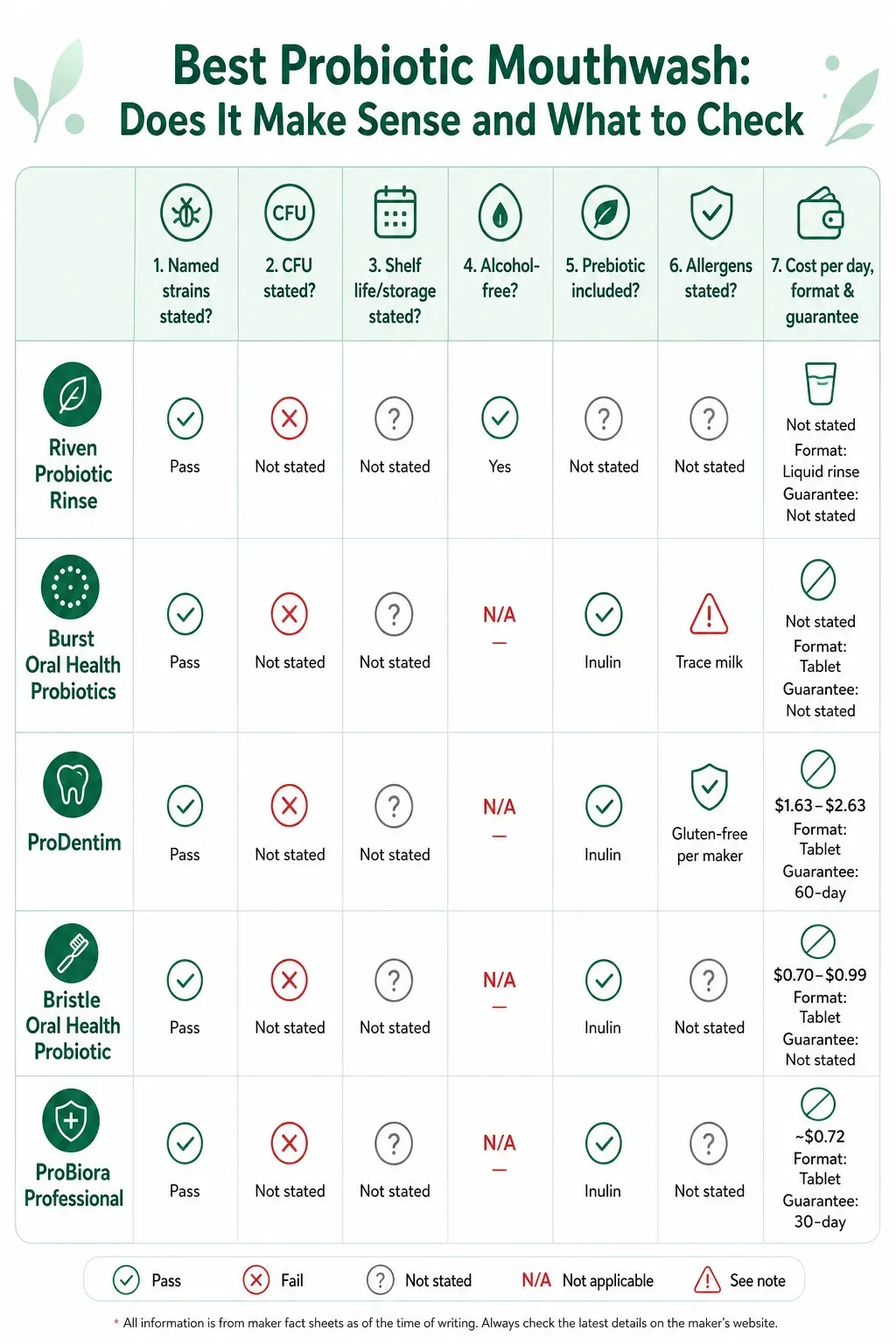
Four things decide whether a probiotic product is worth your money: named strains, a live-culture count you can trust, sensible ingredients, and the price per use.
Live-culture claims and named strains
Look for strain names, not just the words “probiotic blend.” The names to watch for include:
- the mouth-friendly bacteria called K12 (Streptococcus salivarius K12, sold as BLIS K12)
- BLIS M18
- Lactobacillus reuteri
- Lactobacillus brevis
- Lactobacillus paracasei
CFU count means colony-forming units, which is the number of live bacteria in a dose. It’s most useful when the maker guarantees it through the expiry date, not just at the factory.
Shelf life and storage
Check whether the product needs to go in the fridge, and look at the expiry date. Live cultures tend to fade faster in water-based liquids than in dry tablets.
Ingredients to look for and avoid
Alcohol and strong antiseptics can work against live bacteria, so alcohol-free formulas are the better bet. Prebiotic fibers such as inulin are a plus. So is xylitol, a sugar alternative.
Price per use
Divide the price by the number of daily doses. Some prices look low until you notice the dose is two a day.
Named strains, a stated CFU count and no alcohol are the basics.
Probiotic mouthwash compared: rinses versus chewables and lozenges
Chewables and lozenges usually beat rinses on dose clarity. A rinse spends 30 to 60 seconds in your mouth before you spit it out, while a tablet dissolves slowly in saliva.
Comparison table
| Product | Format | Key strains | Price per month | Guarantee |
|---|---|---|---|---|
| ProDentim | Chewable tablet | L. paracasei, L. reuteri, B. lactis BL-04 | $49–$79 (by bundle) | 60-day money-back |
| Burst Oral Health Probiotics | Lozenge, 45 per pack | BLIS K12, BLIS M18 (6 strains stated, 2 named) | Not stated per month; $29.99 sale per pack | Not stated |
| Bristle Oral Health Probiotic | Dissolving mint | K12, M18, L. reuteri, L. plantarum, L. salivarius, B. lactis | $27–$29.99 (1 mint daily) | Not stated |
| ProBiora Professional | Tablet, 90 count | S. uberis KJ2, S. oralis KJ3, S. rattus JH145 | About $21.65 ($64.95 for 90 days) | 30-day money-back |
| Riven Probiotic Rinse | Liquid rinse, alcohol-free | Not listed | Not stated | Not stated |
How to read it
Compare the strains and refund terms first, then the price.
- Convenience and refund window: ProDentim, with one chew a day and 60 days to ask for a refund.
- K12 and M18: Burst or Bristle.
- Lowest listed monthly cost: ProBiora Professional, if $64.95 turns out to be a one-time price. The listing doesn’t make that clear.
For the easy all-round option with named strains and a 60-day refund window, check ProDentim’s current pricing on the official site.
Visit the official ProDentim site60-day money-back guarantee
ProDentim
ProDentim is a daily chew with three named strains plus inulin. The maker says it supports oral bacterial balance and healthy gums.
Pros
- One chew each morning
- Named strains and a stated total of 3.5 billion
- 60-day money-back guarantee
- $49 a bottle in the six-bottle bundle
Cons
- A single bottle isn’t sold on its own; the smallest order is two bottles at $79 each, plus $9.99 shipping
- Amounts per strain aren’t listed
- Buy only from the official site
The maker hasn’t published a study of ProDentim itself. You can read more in our full ProDentim breakdown.
Check today’s ProDentim bundle and refund terms on the official site.
Visit the official ProDentim site60-day money-back guarantee
Burst Oral Health Probiotics
Burst makes lozenges with BLIS K12 and BLIS M18. The maker says they target odor-causing bacteria and tonsil stones.
Pros
- Two well-known named strains
- 6 billion CFU stated
Cons
- Only two of the six strains are named
- May contain trace milk protein
- Free shipping only on orders over $50
Bristle Oral Health Probiotic
Bristle’s mint lists six strains plus xylitol.
Pros
- The widest strain list in this comparison
- Subscriptions can be paused
Cons
- Two mints a day doubles the cost
- The serving basis for the CFU claim isn’t stated
ProBiora Professional
ProBiora Professional is a once-daily tablet with three patented Streptococcus strains.
Pros
- 2.5 billion CFU per tablet
- A 90-day supply per bottle
Cons
- It’s unclear whether the listed price is a subscription
- 30-day guarantee terms aren’t stated
Riven Probiotic Rinse
Riven is an alcohol-free concentrated probiotic mouthwash.
Pros
- A true rinse format
- Alcohol-free
Cons
- No strains or CFU count listed
- Price and guarantee not stated
How to choose
- Are the strains named?
- Is the CFU count stated?
- Is it alcohol-free?
- What does a month cost at the dose you’d actually take?
- Is there a clear refund window?
Which is better for bad breath: probiotic or antibacterial mouthwash?
For quick odor control, antibacterial mouthwash works faster. A probiotic is meant as a slower, daily habit. Many people use both, at different times of day.
How each works
Bad breath (halitosis) comes mostly from volatile sulphur compounds made by mouth bacteria. These are smelly gases released as bacteria break down proteins. The same review notes that plaque control is the basis of fresher breath, and that rinses play a supporting role.
Antibacterial rinses kill surface bacteria. Probiotics aim to shift the balance of bacteria in your mouth. One trial found that two commercial probiotic products didn’t lower breath gases at 2 hours, so don’t expect an instant fix.
When to choose which
- Need fresh breath before a meeting? Reach for a regular mouthwash.
- Using chlorhexidine? Treat it as a short-term tool. It controls gum inflammation but can stain teeth.
- Using both? Space the antiseptic rinse and the probiotic apart.
If bad breath lasts for weeks, see a dentist.
Does it help gums, plaque and tonsil stones?
For gums and dental plaque, a probiotic may help a little, and the effect depends on the strain. For tonsil stones, the evidence is limited.

Gums and plaque
Small rinse trials show modest drops in plaque and gingivitis scores. The children’s study linked its plaque results partly to lower levels of Streptococcus mutans, a main cavity germ. That’s no promise of fewer dental caries (cavities), though. Keep up fluoride toothpaste and checkups. Our guide to probiotics for gum health covers more.
Tonsil stones
Rinses reach the tonsils less than a lozenge that dissolves at the back of the mouth does. Give any product a few weeks of daily use before you judge it, and ask a dentist or doctor about stones that keep coming back.
Is probiotic mouthwash good for gut health or when taking antibiotics?
No. A mouth rinse is an oral-health product, not a gut-health product.
If you’re on an antibiotic such as nitrofurantoin, ask your pharmacist about timing, because antibiotics can reduce live bacteria. Never stop a prescribed medicine to make room for a probiotic.
Who it’s not for and what it can’t do
- Skip live cultures if you’re immunocompromised, have a central line or a serious illness, or have been told to avoid them. Talk to your doctor first.
- Check allergens, such as trace milk in some lozenges.
- A probiotic doesn’t treat gum disease or cavities, and it doesn’t replace brushing, flossing or dental visits.
Where this fits in oral probiotics
Rinses are just one way to take oral probiotics. For the basics on how these bacteria work in your mouth, start with our guide to what oral probiotics are and what’s known. If breath is your main worry, compare tablet options in our roundup of the best oral probiotics for bad breath.
Our pick: when a chewable oral probiotic makes more sense
For most readers, ProDentim is the best pick by our criteria: a single daily chew, three named strains, a 60-day refund window and a $49-per-bottle bundle price. The maker says it supports oral bacterial balance and healthy gums.
The maker’s directions are one tablet each morning. Many people take oral probiotics after brushing and avoid food and drink for a while afterward.
If you want K12 and M18 specifically, Burst or Bristle may suit you better. If you strongly prefer a liquid, Riven is the rinse to look at.
Quick tip: Keep your regular mouthwash for a different time of day than your probiotic.
Try ProDentim with the 60-day money-back guarantee, and check the bundle pricing on the official site.
Visit the official ProDentim site60-day money-back guarantee
Frequently asked questions
How often should I use probiotic mouthwash?
Follow the label. Riven’s maker suggests 1 to 2 teaspoons, swished for 30 to 60 seconds, once or twice daily. Most rinse trials used a probiotic rinse twice a day, alongside normal brushing and flossing, rather than as a replacement for them.
Can I use probiotic mouthwash after regular mouthwash?
It’s better to space them apart. Antiseptic or alcohol rinses can kill live cultures. Use the regular mouthwash at one time of day and the probiotic at another, or wait a while between them. ProBiora’s maker suggests waiting 30 minutes.
Does probiotic mouthwash need refrigeration?
It depends on the product, so check the label and the expiry date. Live bacteria usually last longer when they’re cool and dry, which is one reason many oral probiotics come as tablets or lozenges. If the label says to refrigerate, follow it.