Persistent Bad Breath: What to Try and When to See a Professional
We may earn a commission when you buy through links on this page, at no extra cost to you. Learn more
There's no single permanent bad breath cure, because the fix depends on the cause. Most cases start with mouth bacteria, so brush twice a day, clean between teeth and your tongue daily, drink water, and keep up dental checkups. If breath is still bad after about two weeks, see a dentist.
ProDentim: A chewable probiotic supplement marketed for teeth, gums, and oral bacterial balance.
Visit the official ProDentim site60-day money-back guarantee

On this page
- What causes bad breath that won’t go away?
- Step-by-step routine: how to stop bad breath from smelling bad
- Which mouthwash actually helps, and what does it cost?
- Do baking soda and other home remedies work?
- Printable checklist: your 14-day bad breath routine
- When should you see a dentist or doctor about bad breath?
- Can oral probiotics support a fresh-breath routine?
- Where this fits in the bigger picture
What causes bad breath that won’t go away?
Persistent bad breath, called halitosis, usually starts in the mouth, and the cause decides which step will help you most. One review says the mouth is the main source in healthy people, especially the back of the tongue. For a wider look, see our guide on what are the causes of bad breath.
Bacteria and volatile sulfur compounds
Volatile sulfur compounds are smelly gases made by mouth bacteria, and they are the source of “sulfur breath.” A clinical trial report explains that bacteria break down proteins in debris and plaque into hydrogen sulfide and methylmercaptan. Plaque is the sticky film of bacteria on teeth.
Dry mouth and morning breath
Dry mouth means too little saliva, and it explains why breath is worse on waking. Saliva rinses the mouth, and your mouth naturally dries out while you sleep. So if your girlfriend, or anyone, has stale breath first thing, that’s often the reason. Mouth breathing and some medicines make it stronger.
Gum disease and tooth decay
Gum disease and tooth decay can add odor that brushing alone won’t fix. Gum disease can cause bad-smelling breath and an unpleasant taste. If you notice bleeding gums, that’s a reason to book a visit.
Foods, smoking and keto-style diets
Garlic, onions, smoking and low-carb diets can each add odor. Smoking can change the balance of microbes in your mouth and cause dry mouth. Starting a diet such as keto may also bring a certain breath odor. Food odor fades. Mouth odor that stays points to the steps below.
Step-by-step routine: how to stop bad breath from smelling bad
The most reliable routine is brushing, cleaning between teeth, cleaning your tongue, and keeping saliva flowing. Plaque between teeth and on the back of the tongue holds most odor bacteria, so each step targets one hiding place.
Step 1: Brush twice daily for two minutes
Brushing twice daily for two minutes with fluoride toothpaste removes plaque before it makes odor. Brush gently along the gumline and don’t rush.
Step 2: Floss or clean between teeth every day
Flossing or using interdental brushes removes food and plaque your brush can’t reach. Do it once a day. Dentures should come out at night and be cleaned daily, since poorly cleaned dentures collect bacteria and food.
Step 3: Clean your tongue
Tongue cleaning, or tongue scraping, once a day is one of the highest-value steps. A review notes the major source of oral malodor is the tongue. Scrape from back to front with gentle pressure, and rinse the scraper. Our guide on how to scrape your tongue has details.
Quick tip: If you gag, start mid-tongue and move back a little each day.
Step 4: Drink water and keep saliva flowing
Water intake through the day helps keep saliva flowing. Pick water over sugary or caffeinated drinks, and limit alcohol and coffee, which can dry the mouth.
Step 5: Rinse smartly and chew sugar-free gum
Sugar-free gum between meals helps saliva rinse the mouth. Chewing sugar-free gum or sucking sugar-free candy boosts saliva. A rinse can be a bonus, covered next.
What to expect: many people notice a difference within days to two weeks. Gum problems take longer and need a dentist.
Which mouthwash actually helps, and what does it cost?
Therapeutic mouthwash targets bacteria, while cosmetic rinses mostly mask odor for a short time. Some mouthwashes only mask odors; others fight the bacteria. Look for the bacteria-fighting kind.
Therapeutic rinses: cetylpyridinium chloride, chlorine dioxide, chlorhexidine
Cetylpyridinium chloride and chlorine dioxide are common antibacterial ingredients in over-the-counter rinses. Chlorhexidine is a stronger rinse a dentist advises for short periods, not for daily long-term use. Antibacterial rinses are advised if hygiene and tongue cleaning aren’t enough.
Cosmetic rinses and essential oils
Cosmetic rinses freshen breath briefly. Essential oil products vary, and a toothpaste review found data on essential oils for malodor are few and inconclusive. If your mouth is dry, skip alcohol-heavy rinses.
Rough cost comparison
These are general ranges, not quotes, and prices vary by store and country.
| Item | Typical cost | Best for |
|---|---|---|
| Cosmetic rinse | Low | Short-term freshness |
| Therapeutic rinse (CPC or chlorine dioxide) | Low to mid | Bacteria on tongue and teeth |
| Chlorhexidine | Dentist-advised, varies | Short-term use only |
| Tongue scraper | Low, one-time | Daily tongue cleaning |
| Floss or interdental brushes | Low | Between teeth |
| Sugar-free gum | Low | Saliva between meals |
| Dental visit and cleaning | Highest, varies widely | Finding the cause |
A scraper and floss give the most value per dollar.
Do baking soda and other home remedies work?
Baking soda toothpaste shows modest benefits, and other home remedies have little solid support. None replace cleaning and checkups.
Baking soda
Baking soda toothpaste has some support. In controlled crossover studies, two high baking-soda toothpastes reduced oral malodor. Yet a later review calls data on baking soda in toothpastes few and inconclusive. A homemade rinse of 2 teaspoons in a cup of warm water is mostly a short-term freshener.
Parsley, pineapple juice and similar remedies
Parsley and pineapple juice are optional extras at best. Healthline says they may help reduce bad breath that starts in the mouth, but solid trials are thin. Enjoy them if you like, and keep the routine going.
Printable checklist: your 14-day bad breath routine
A 14-day checklist gives you a fair test of your routine and a clear decision at the end. Tick each box daily.
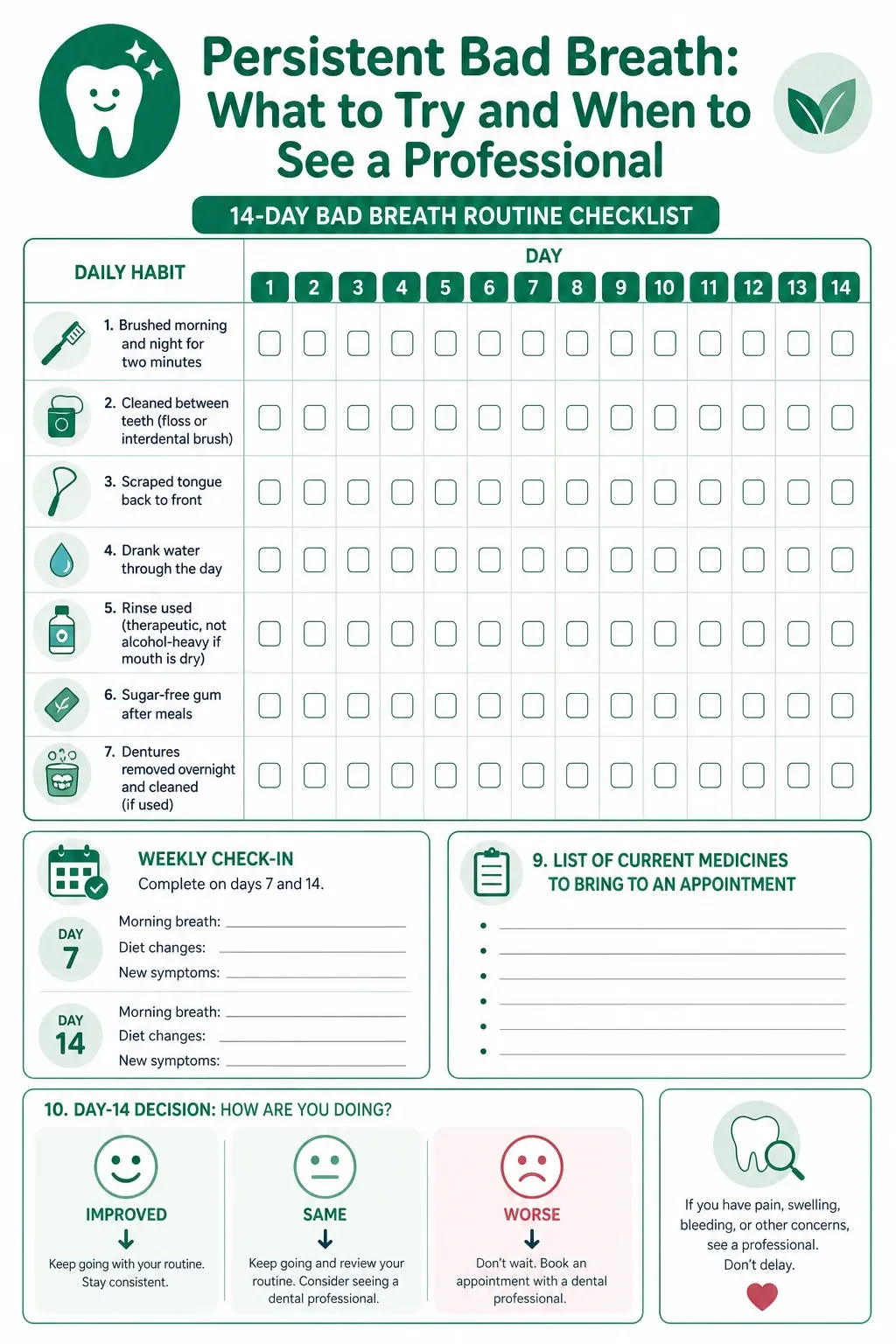
Day-14 decision
- Improved: keep going and keep your regular dental checkups.
- Same: book a dentist visit.
- Worse, or new symptoms: book a visit soon.
If your breath still smells after brushing, read why breath can stay bad after brushing.
Visit the official ProDentim site60-day money-back guarantee
When should you see a dentist or doctor about bad breath?
See a dentist first if breath hasn’t improved after about two weeks, and a doctor if your mouth looks healthy. Dentists usually diagnose bad breath and refer you on if no oral cause is found.
See a dentist if
- Gums bleed or are swollen
- Teeth feel loose or you suspect cavities
- You have a lasting bad taste
- Two weeks of steady care changed nothing
- Your checkup is overdue
See a doctor if
A doctor can help when the mouth is healthy but odor continues, or with reflux, sinus or throat problems. Diabetes raises gum disease risk, and ketoacidosis can make breath smell fruity. Get prompt advice for fruity or ammonia-like smells. Bring a list of your medicines, since many cause dry mouth. This page isn’t a diagnosis and doesn’t replace professional care.
Can oral probiotics support a fresh-breath routine?
Oral probiotics are an optional extra after the basic steps, and research is early. A review says probiotics may help regulate oral flora, but results vary and they’re not a cure. See our pages on probiotics for bad breath, oral probiotics and the best oral probiotics for bad breath.

ProDentim is a chewable probiotic. The maker says it supports oral bacterial balance and healthy gums and teeth, and the maker says to chew one tablet each morning. The maker hasn’t published a study of ProDentim itself. The maker says it offers a 60-day money-back guarantee, and the maker lists $79 a bottle for two bottles, with larger bundles cheaper per bottle.
Check the current ProDentim offer and the 60-day refund terms on the official site.
Visit the official ProDentim site60-day money-back guarantee
Where this fits in the bigger picture
Persistent bad breath has several possible causes, and the routine above targets the most common one: bacteria in the mouth. For the full list, from dry mouth to reflux, read what causes bad breath. If your breath stays stale even with good habits, why breath still smells after brushing covers the usual hidden reasons. Your best next step is simple: start the 14-day checklist today, and book a dentist visit if day 14 looks the same.
Frequently asked questions
How long does it take for bad breath to go away?
Many people notice a difference within days to two weeks of steady brushing, cleaning between teeth and tongue cleaning. Gum problems take longer and need a dentist. If breath hasn’t improved after about two weeks, book a dental visit to look for the cause.
Can tonsil stones cause bad breath?
Yes. Tonsil stones are bad-smelling calcium deposits that form when food gets stuck in the tonsils at the back of the throat. Gargling and good hygiene may help, but if you see them often or have throat pain, ask a dentist or doctor.
Does keto breath go away?
Keto-style diets can change breath odor, and it may ease as your body adjusts or if you change your eating. Drinking more water, cleaning your tongue and chewing sugar-free gum can help meanwhile. If the smell is fruity or strong and lasting, ask a doctor.