Oral Probiotics: What They Are, How They Work and How to Choose One
We may earn a commission when you buy through links on this page, at no extra cost to you. Learn more
Oral probiotics are friendly bacteria you take as a chewable, lozenge or tablet so they settle in your mouth and help keep its bacteria in balance. Strains like S. salivarius K12 and L. reuteri are the most studied for fresher breath and healthier gums, used alongside brushing, flossing and dental check-ups.
ProDentim: A chewable probiotic supplement marketed for teeth, gums, and oral bacterial balance.
Visit the official ProDentim site60-day money-back guarantee
On this page
- Start here
- What are oral probiotics, and how are they different from gut probiotics?
- How do mouth probiotics actually work?
- Which oral probiotic strains have research behind them?
- Do oral probiotics really work for bad breath, gums and cavities?
- Can oral probiotics be taken with antibiotics like nitrofurantoin or minocycline?
- How to take an oral probiotic: timing, format, side effects and cost
- Quiz: is an oral probiotic right for you, or should you see a dentist first?
Start here
Oral probiotics make the most sense when you know what you want them for, so pick the guide that matches your goal.
- Best oral probiotics for bad breath: products compared for fresher breath, by strain and format.
- Best oral probiotics: picks focused on teeth and gums, with clear criteria.
- Oral probiotic lozenges: lozenges and chewables side by side, and how each one dissolves.
- Oral probiotic strain guide: what each named strain was studied for.
- ProDentim: our full review of one chewable option, its ingredients and price.
Pick one goal, then read the guide built for it.
What are oral probiotics, and how are they different from gut probiotics?
Oral probiotics are live bacteria made to work in your mouth, not your gut. They usually come as a lozenge (a tablet you let melt) or a chewable tablet, so the bacteria touch your teeth, gums and tongue for a while.
Think of your mouth like a lawn. If good grass fills every patch, weeds have less room. That community of mouth bacteria is called the oral microbiome, and balancing it is the whole goal.
Here’s the big difference from gut capsules:
- Gut probiotics are picked to survive stomach acid and reach the intestines.
- Mouth strains are chosen for clinical evidence in a specific oral condition, such as bad breath or gum irritation.
- A gut capsule you swallow whole spends almost no time in your mouth.
So which probiotic is best for oral health? One with a named strain that has been studied in the mouth, in a format that dissolves slowly. A 2024 review of oral care strains found many products use bacteria with no documented benefit in the mouth, chosen mainly because they’re safe in food.
A mouth probiotic is about where the bacteria land, not just what they are.
How do mouth probiotics actually work?
Mouth probiotics work in three main ways: they compete for space, some make natural bacteria-blocking compounds, and some may calm the gum’s inflammatory response.
First, a quick word on plaque. It’s a sticky film of bacteria that builds on teeth every day. Left alone, it can irritate gums and feed decay.
Crowding out harmful bacteria
Some studied strains may reduce levels of oral pathogens or bacteria linked to bad breath. The British Dental Journal overview advises using oral probiotics daily on top of your usual oral hygiene. Follow the directions for your product.
Making natural inhibitors
Some oral probiotic strains may produce antimicrobial compounds that inhibit harmful bacteria. A British Dental Journal overview lists making antimicrobial compounds as one of the main ways oral probiotics may help. If you’ve wondered what kills bacteria naturally in the mouth, your saliva, brushing, flossing and tongue cleaning do most of that daily work.
Calming the gum response
Some strains may help settle the body’s inflammatory response in the gums. That same British Dental Journal piece names reducing inflammation as a second likely route.
Probiotics nudge the balance; your toothbrush still does the heavy lifting.
Which oral probiotic strains have research behind them?
A handful of oral probiotic strains have human trials, led by Streptococcus salivarius strains and certain lactobacilli, while many label names are just marketing.
Results are strain-specific. A finding for one strain doesn’t carry over to another, even within the same species.
| Strain or blend | Mainly studied for | Research status |
|---|---|---|
| Streptococcus salivarius K12 (BLIS K12) | Bad breath | Small trials; among the best studied |
| BLIS M18 (Streptococcus salivarius M18) | Bad breath, plaque, cavities | Small trials; mixed on plaque |
| Lactobacillus reuteri | Gum inflammation, plaque | Small trials; some positive results |
| Lactobacillus acidophilus | General use | Often listed by species only |
| Bifidobacterium and Bacillus | General use | Little to no oral support |
Streptococcus salivarius K12 and M18
These are mouth-native strains. The 2024 strain review found Streptococcus species have the strongest support in the mouth. Read more in our guide comparing BLIS K12 and M18.
Lactobacillus reuteri
A small study of 59 people with gingivitis found less gum irritation and plaque with L. reuteri after two weeks, mainly at the highest dose.
Lactobacillus paracasei, rhamnosus and acidophilus
These have mixed support. They often appear at species level only, with no strain code, which makes the claims hard to check.
ProBiora3 blend and other multi-strain mixes
Multi-strain blends exist too. Check any blend for strain codes and published trials.
Quick tip: Read labels for genus, species and strain code (like “S. salivarius K12”) plus CFU (colony-forming units), the count of live bacteria. A bigger CFU number isn’t automatically better; the right strain at a studied dose matters more.
No strain code, no way to match it to research.
Do oral probiotics really work for bad breath, gums and cavities?
Oral probiotics show the most promise for bad breath, mixed results for gums and plaque, and only limited evidence for cavities.

Bad breath
Halitosis (bad breath) has the best-looking results. A 2025 review of six trials with 360 people found most showed drops in sulfur gases, especially with K12, though trials were short and varied. A 2021 meta-analysis of four trials found no clear overall effect. In a trial of 64 people with braces, M18 lozenges lowered odor gases but barely changed plaque or gum scores.
Gum health and plaque
For gum disease (periodontal disease), probiotics look most useful alongside a dentist’s deep cleaning. A 2024 network meta-analysis of 33 studies found Lactobacillus added to professional cleaning helped gum pocket measures. Another 2024 review found antibiotics did better on plaque scores, and combining both worked best.
Cavities
For dental caries (cavities), some specific strains show early promise. Fluoride toothpaste remains the proven foundation.
Oral thrush and dry mouth
Evidence here is limited. White patches or a constantly dry mouth deserve a visit to a dentist or doctor.
Who paid for a study matters. Check each study’s funding and conflict-of-interest disclosures. Small size, short follow-up and no placebo group are signs to read results lightly.
Breath is the strongest case; gums and cavities still belong with your dentist.
Can oral probiotics be taken with antibiotics like nitrofurantoin or minocycline?
Ask your prescriber or pharmacist whether an oral probiotic is appropriate during your antibiotic treatment, including nitrofurantoin or minocycline.
Antibiotics kill bacteria, including the live ones in a probiotic. Ask your pharmacist whether spacing is needed for your specific antibiotic and probiotic.
A few clear points:
- Nitrofurantoin is used for urinary tract infections. Ask your pharmacist about any supplements you plan to take with it.
- Minocycline, often used for skin, is a tetracycline antibiotic. Ask your pharmacist about timing.
- A probiotic doesn’t treat the infection the antibiotic is for. Finish the prescription as directed.
- If your immune system is weakened, talk to your doctor before any probiotic.
After antibiotics, some people notice a coated tongue, odd taste or white patches. White patches that don’t wipe away easily, or a sore mouth, should be checked.
Your prescriber’s advice comes first, every time.
How to take an oral probiotic: timing, format, side effects and cost
Follow the directions on your product’s label. ProDentim’s maker, for example, recommends slowly chewing one tablet each morning.
Lozenge vs chewable
One M18 trial used lozenges, while ProDentim is a chewable tablet. Use the method the product label specifies.
After-brushing routine
Keep up your routine of brushing, flossing and cleaning your tongue. Brushing helps remove plaque. Follow the probiotic’s label directions.
Safety, allergens and sweeteners
Check the label for sweeteners like xylitol, isomalt or stevia, plus added fibers such as inulin. Look for dairy and other allergens. Probiotics are generally considered safe, but people at high risk of infection should avoid them unless a doctor agrees. Children and pregnant people should check with a doctor first.
How long before you notice anything
The gingivitis study checked people after two weeks, and the M18 braces trial used a one-month intervention. Results vary, and many people notice little. Compare cost per serving, not per bottle.
One chewable example is ProDentim. The maker says it combines 3.5 billion bacteria across three strains, including Lactobacillus paracasei and L. reuteri, and recommends one tablet chewed slowly each morning. The maker hasn’t published a study of ProDentim itself. Bottles run $49 to $79 each depending on bundle, with a 60-day money-back guarantee, according to the maker.
Cost per day and the strain list tell you more than the front of the box.
Quiz: is an oral probiotic right for you, or should you see a dentist first?
An oral probiotic fits best if your mouth is healthy and you want extra support; certain symptoms mean a dentist comes first.
See a dentist first if you have:
- Gums that bleed often or look swollen
- Loose teeth or receding gums
- Bad breath that lasts weeks despite good cleaning
- Tooth or gum pain
- White patches or sores that don’t heal
Take the quick quiz to see where you land.
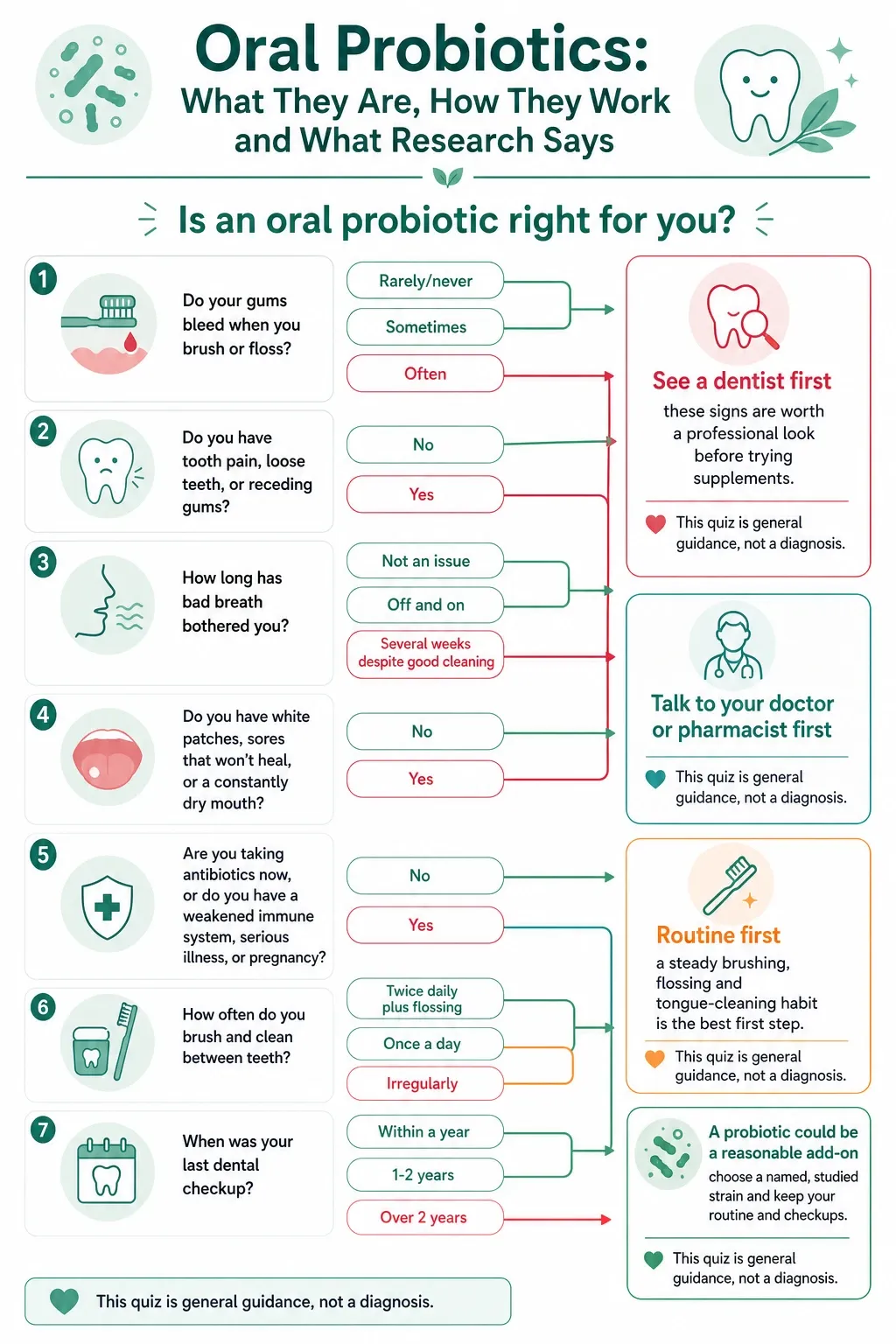
Your result points you to one of three paths: tune up your daily routine, try a probiotic as an add-on, or book a dental visit. It’s a guide, not a diagnosis.
If your result says a probiotic could be a reasonable add-on, compare strains and refund terms before you buy. Check the current ProDentim bundles and 60-day refund terms on the official site.
Visit the official ProDentim site60-day money-back guarantee
Whatever you choose, keep brushing twice a day with fluoride, clean between your teeth, and keep your dental checkups.
Frequently asked questions
Are oral probiotics safe to take every day?
For most healthy adults, oral probiotics are generally considered safe for daily use, and most products are designed that way. People with weakened immune systems, serious illness or pregnancy should ask a doctor before starting any probiotic.
Can I take an oral probiotic and a gut probiotic together?
Ask a pharmacist or clinician whether combining your specific products is appropriate for you. Follow each product’s administration instructions. If you have a health condition or take medication, check with a pharmacist first.
Do oral probiotics replace mouthwash or brushing?
No. Oral probiotics are an add-on, not a replacement. Brushing twice a day with fluoride toothpaste and cleaning between teeth remove plaque, which probiotics can’t do. Ask your dentist how to fit a probiotic around any mouthwash you use.
Can children use oral probiotics?
Some oral probiotic products are made for children. Even so, ask your child’s dentist or doctor first, follow the product’s age guidance, and watch for choking risk with lozenges in young children. Kids still need fluoride and regular checkups.
How long does an oral probiotic stay in the mouth?
The published studies here don’t say how long oral probiotic bacteria stay in the mouth. The British Dental Journal overview recommends daily use as an addition to oral hygiene. Follow any food, drink or rinsing instructions on the product label.
Do oral probiotics need to be refrigerated?
It depends on the product. Check the storage instructions for your specific product. Follow the label, keep the container sealed and away from heat and moisture, and check the expiry date.